Guides
Straight answers for fiber network buyers
Short, practical guides on the questions that decide a fiber network order: which connector and polish to use, which fiber goes where, whether a split fits the optical budget, how MPO polarity works, how to specify ADSS and how to send a BOM that can be quoted in days.
-

Fiber optic cable prices in 2026: what fiber, cable and FTTH parts cost from China
Indicative FOB China prices for G.652.D fiber, duct and ADSS cable, FTTH drop cable, PLC splitters, patch cords, MPO trunks and transceivers in October 2026, why fiber prices jumped this year, and what moves a quote.
Short answer China's G.652.D fiber costs about 4–5 times what it did in 2025, so any cable price list from before 2026 is out of date
-
G.652.D vs G.657.A1 vs G.657.A2: which fiber for FTTH?
What separates G.652.D from bend-insensitive G.657.A1, A2 and B3 fiber, where each belongs in an FTTH network, and why they splice together without trouble.
Short answer G.652.D for backbone and feeder cable; G.657.A1 for distribution; G.657.A2 (or B3) for drops and indoor routes
-

PLC splitter ratios and the GPON loss budget: a worked example
How to check whether a 1×32 or 1×64 split fits your GPON optical budget: splitter loss, fiber, connectors and splices added up, with a worked example and the class B+ and C+ limits.
Rule Total link loss must stay inside the OLT/ONT class budget, with a margin left over
-

MPO polarity explained: Methods A, B and C
How Type A, B and C MPO trunks and A-to-B or A-to-A patch cords keep transmit connected to receive, which method suits parallel optics, and how to state polarity in an order.
The goal Every transmitter must reach a receiver at the far end
-

ADSS cable: price per km, span, sag and sheath
What ADSS cable is, what it costs per km by fiber count and span (FOB China, October 2026), how it differs from OPGW, and what a cable maker needs to design it: span, sag, loading, voltage, sheath.
What ADSS is All-dielectric self-supporting cable, hung between poles with no messenger wire
-
How to send an FTTH bill of materials for a fast, accurate quote
The fields that let a supplier quote an FTTH or fiber-network BOM in days instead of weeks: item, specification, quantity, unit, standard, packaging and delivery plan, with an example.
Fastest format A spreadsheet with one line per item and the specification spelled out
-
Pre-terminated fiber optic cable: drop cable, MPO trunks & factory vs field specs
Pre-terminated fiber optic cable & drop cable guide: factory terminated vs field termination, MPO/SC/LC specs, ≤ 0.25 dB IL test reports & 3–7 day BOM quotes.
What it is Fiber cable with connectors fitted, polished and interferometer-checked in the factory, installed by plugging in instead of splicing on site
-
Single-mode vs multimode fiber: differences, reach and cost
Single-mode (OS2) and multimode (OM1–OM5) fiber compared: core size, light source, reach at 1G to 400G, jacket colours, what each costs and which to choose for FTTH, campus and data centre links.
Short answer Single-mode for anything longer than a few hundred metres and for every FTTH network; multimode only for short links inside a building or data centre
-
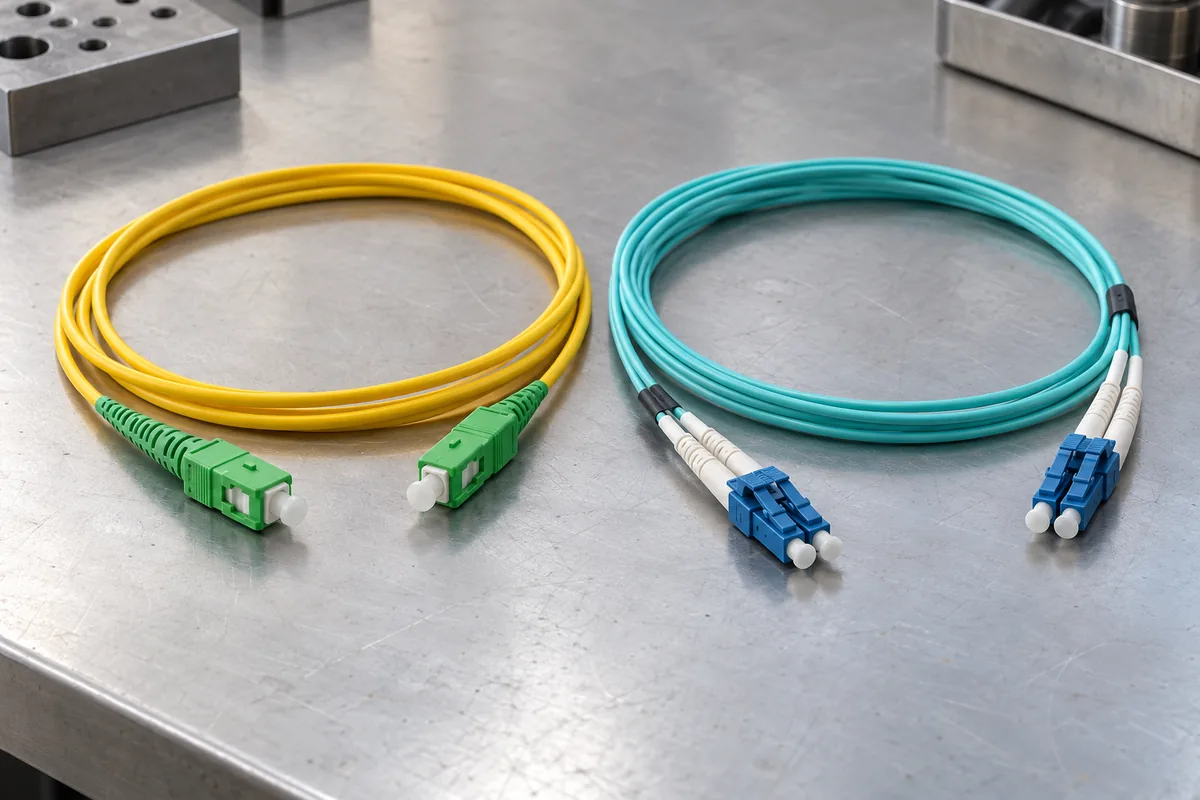
Fiber optic connector types: LC vs SC, UPC vs APC
Fiber optic connector types compared: LC vs SC, FC, ST & MPO, plus LC/SC UPC (blue, ≤0.2 dB typ. IL) vs APC (green, ≥60 dB RL). Send your BOM for a quote.
Short answer LC (1.25 mm) for SFP modules & dense panels, SC (2.5 mm) for FTTH, FC for test gear, ST for legacy multimode, MPO for 8–24F parallel optics. APC (green) on PON, UPC (blue) on Ethernet.
-
GPON vs EPON: rate, split and reach
GPON (ITU-T G.984) is 2.488 Gbit/s down and 1.244 Gbit/s up, split up to 1:128. EPON (IEEE 802.3ah) is a 1.25 GBd line over 10 or 20 km. No prices.
Line rate GPON downstream is 2.48832 Gbit/s. The usual upstream is 1.24416 Gbit/s. EPON is a 1.25 GBd line (1 Gbit/s at the MAC).
-
GPON to XGS-PON on the same fiber: check the loss budget before you swap the optics
Before you swap GPON optics for XGS-PON on the same fiber, check the loss budget. Class N1's extra decibel is already allocated to the coexistence filter.
N1 vs B+ The extra 1 dB in class N1 (29 dB against 28 dB) is already allocated to the WDM1r
-
Fiber optic test reports: what to ask for on patch cords, pigtails, PLC splitters and MPO
What to require on a test report for patch cords, pigtails, PLC splitters and MPO: loss, return loss, endface, OTDR, typical versus maximum, and sample size.
Insertion loss IEC 61300-3-4 measures attenuation. A power meter is the reference method. OTDR is an alternative. The report must name which one.
Get a matched quote
Send your BOM
Upload a spreadsheet or tender, or paste the list. We match every line to a qualified factory and return one priced BOM, usually within 3 to 7 working days.
- Emailsales@zerolineai.com
- WhatsApp+44 7762 362563
- OfficeWuhan, Hubei, China