Fiber optic connector types: LC vs SC, UPC vs APC
Fiber optic connector types compared: LC vs SC, FC, ST and MPO, plus UPC vs APC. Ferrule size, colour, return loss and which to order for FTTH or a data centre.
What are the fiber optic connector types?
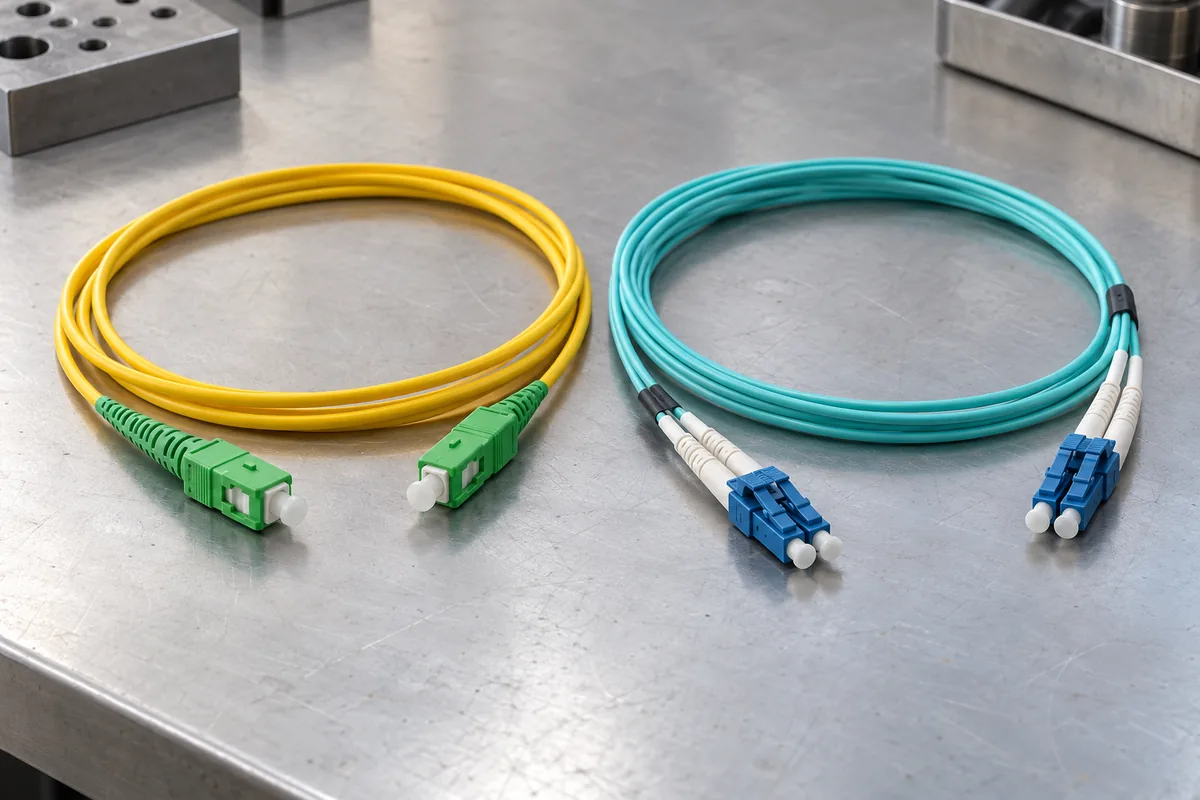
The fiber optic connector types in ordinary orders are LC, SC, FC, ST and MPO. The first four put one fiber in a round ferrule. MPO puts many fibers in one rectangular ferrule. LC vs SC is a choice of size and of what the port was built for, not of fiber. UPC vs APC is a choice of polish, and it matters more to the link than the body style does.
| Connector | Ferrule | How it latches | Where it is used | Polish |
|---|---|---|---|---|
| LC | 1.25 mm | Latch, like an RJ45 | SFP, SFP+ and SFP28 modules; dense panels; uniboot cords | UPC or APC |
| SC | 2.5 mm | Push-pull, square body | FTTH drops, ONTs, termination boxes, ODFs | UPC or APC; APC on PON |
| FC | 2.5 mm | Threaded metal nut | OTDRs, power meters, older transmission gear, high vibration | UPC or APC |
| ST | 2.5 mm | Bayonet, like a BNC | Legacy multimode LANs from the 1990s | PC or UPC, not APC |
| MPO | MT ferrule, 8, 12, 16 or 24 fibers | Push-pull, with a key | Data-centre trunks, 40G/100G/400G parallel optics | State it on the order; see polarity separately |
Ferrule diameters and the names are the ones the Fiber Optic Association records for these connectors. Interface dimensions sit in the IEC 61754 series (LC, SC, FC, ST and MPO are separate parts of that series). The 8° angled end face is the APC optical interface in IEC 61755.
LC vs SC
LC is the small one. The 1.25 mm ferrule is half the diameter of the older connectors, and a duplex LC is about the size of an RJ45 plug, which is why an SFP cage takes LC and nothing else. High-density panels and uniboot cords are LC for the same reason: two fibers, half the width of duplex SC.
SC (subscriber connector) is the larger one. The 2.5 mm ferrule sits in a square plastic body that pushes in and pulls out by the grip, so a gloved installer can seat it on a pole or in a cabinet. FTTH drops, fiber termination boxes and ONTs are built around SC. SC/APC, green, is the usual plug on a PON drop.
Optical performance does not decide LC vs SC. At the same polish and the same grade, both are specified to the same insertion loss. What decides it is the port already on the module, the panel or the box. A hybrid patch cord (LC one end, SC the other) joins the two. Keep the polish the same on that cord.
FC and ST use the same 2.5 mm ferrule as SC. FC screws on, so it stays put on a test set and in vibrating plant; many OTDRs still ship with an FC port. ST twists on with a bayonet. It was the multimode connector of early LANs. Order ST only to match an installed ST panel. New single-mode work does not use it.
UPC vs APC
UPC and APC describe the end of the ferrule, not the body. Both are physical-contact polishes: the fiber cores touch, with no air gap. The difference is the angle.
| UPC | APC | |
|---|---|---|
| End face | Domed, axis straight | Domed, tilted 8° |
| Single-mode colour | Blue | Green |
| Return loss, typical maximum we ship | ≥ 50 dB | ≥ 60 dB |
| Insertion loss, typical maximum | ≤ 0.3 dB | ≤ 0.3 dB |
| Where | Ethernet, data-centre duplex, digital links | GPON, XGS-PON, RF video, any link that cannot tolerate reflection |
| Mate with | UPC only | APC only |
Return loss is how much light bounces back. A higher number is less reflection. An APC face sends that reflection into the cladding, where it is absorbed, which is why PON and video use it. A UPC face sends the reflection straight back at the laser. For a digital Ethernet link that is usually fine. For a PON laser it is not.
Multimode connectors are polished PC or UPC, not APC. The return loss we ship on multimode is typically at least 25 dB, and the insertion loss limit is the same ≤ 0.3 dB. Jackets follow the fiber, not the polish: yellow for OS2, aqua for OM3 and OM4, lime for OM5.
Do not mate UPC to APC. Blue into green leaves a gap at the core, so loss and reflection both jump, and the end faces can be scratched. Adapters will sometimes let you do it. That does not make it a working joint.
MPO, briefly
An MPO connector holds a row of fibers in one ferrule: 8, 12, 16 or 24 on the trunks we build. Parallel optics (40GBASE-SR4, 100GBASE-SR4, 400GBASE-SR8 and the single-mode DR4 and DR8 modules) need that many fibers in one plug. MTP is US Conec’s brand of MPO; it mates with standard MPO. One side of each pair is pinned and the other is not. Which way the fibers run is polarity, and it is a property of the trunk and the patch cords, not of the connector name. The guide on MPO polarity covers Methods A, B and C.
Where each one goes
| The port you are plugging into | Order |
|---|---|
| SFP, SFP+ or SFP28 module | LC. UPC for single-mode Ethernet, the matching multimode grade for SR |
| GPON or XGS-PON drop, termination box or ONT | SC/APC |
| ODF or rack panel in a central office | Whatever the panel is punched for, usually SC/APC on PON and LC/UPC on Ethernet |
| OTDR or optical power meter | The port on the instrument, often FC/APC or SC/APC, plus a launch cord of that type |
| Old multimode patch panel with bayonet adapters | ST, to match it |
| 40G, 100G or 400G parallel optic, or a trunk between racks | MPO, with the polarity method for the site |
| Outdoor drop with a hardened plug | A hardened connector, or SC/APC where the box takes a standard plug |
Field-installable connectors, for terminating a drop on site, are SC/APC or SC/UPC. Factory-terminated cords are the better joint where the length is known: every cord is measured for insertion loss and return loss, and the end-face geometry is checked on an interferometer.
The rack those adapters sit in is a fiber patch panel: a 19-inch panel, a sliding drawer, an LGX cassette or a high-density MPO panel. A wall outlet or an outdoor FAT box is a fiber termination box, not a patch panel.
Which fiber optic connector should I choose?
Choose the connector the equipment already has, then the polish the service needs. Use LC/UPC on single-mode links into SFP modules and on dense data-centre panels, and LC of the right OM grade on short multimode links. Use SC/APC on every GPON and XGS-PON port, including the drop, the termination box and the ONT, because the 8° polish keeps reflected light out of the laser. Use FC where the port is already FC, which is common on test gear, and ST only to extend legacy multimode. Use MPO when the optic is parallel or a trunk has to carry 8 to 24 fibers in one plug, and pick the polarity method once for the whole site. Match the polish at both ends of every cord: blue UPC to blue UPC, green APC to green APC. A hybrid cord can change LC to SC. It cannot change UPC to APC.
What to put on the enquiry
Name four things on every line: connector and polish at each end (for example LC/UPC to SC/APC), fiber (OS2, G.657.A2, OM4), construction (simplex, duplex, uniboot, armoured) and length. For MPO, add the fiber count, pinned or unpinned, and the polarity method.
We supply patch cords and pigtails in LC, SC, FC and ST, UPC and APC, and MPO trunks, harnesses and cassettes. SFP modules take LC. ODN and FTTx boxes and field connectors are SC/APC or SC/UPC. The form below is the enquiry: send the list and we quote it.
Sources
- Fiber Optic Association, “Connector types and terminology” (FC, ST and SC names, 2.5 mm ferrule, physical-contact and angled polishes). thefoa.org
- Fiber Optic Association, “Fiber optic cable color codes” (connector and jacket colours). thefoa.org
- IEC 61754, connector interfaces, and IEC 61755, optical interfaces, including the 8° angled end face used for APC. Named here as the governing standards; the readable account is the FOA page above.
- ZeroLine Connect, “Fiber patch cords and pigtails” (insertion loss ≤ 0.3 dB, return loss ≥ 50 dB UPC and ≥ 60 dB APC, typical maxima). connect.zerolineai.com
Next guide GPON vs EPON: rate, split and reach