Fiber optic test reports: what to ask for on patch cords, pigtails, PLC splitters and MPO
What to require on a test report for patch cords, pigtails, PLC splitters and MPO: loss, return loss, endface, OTDR, typical versus maximum, and sample size.
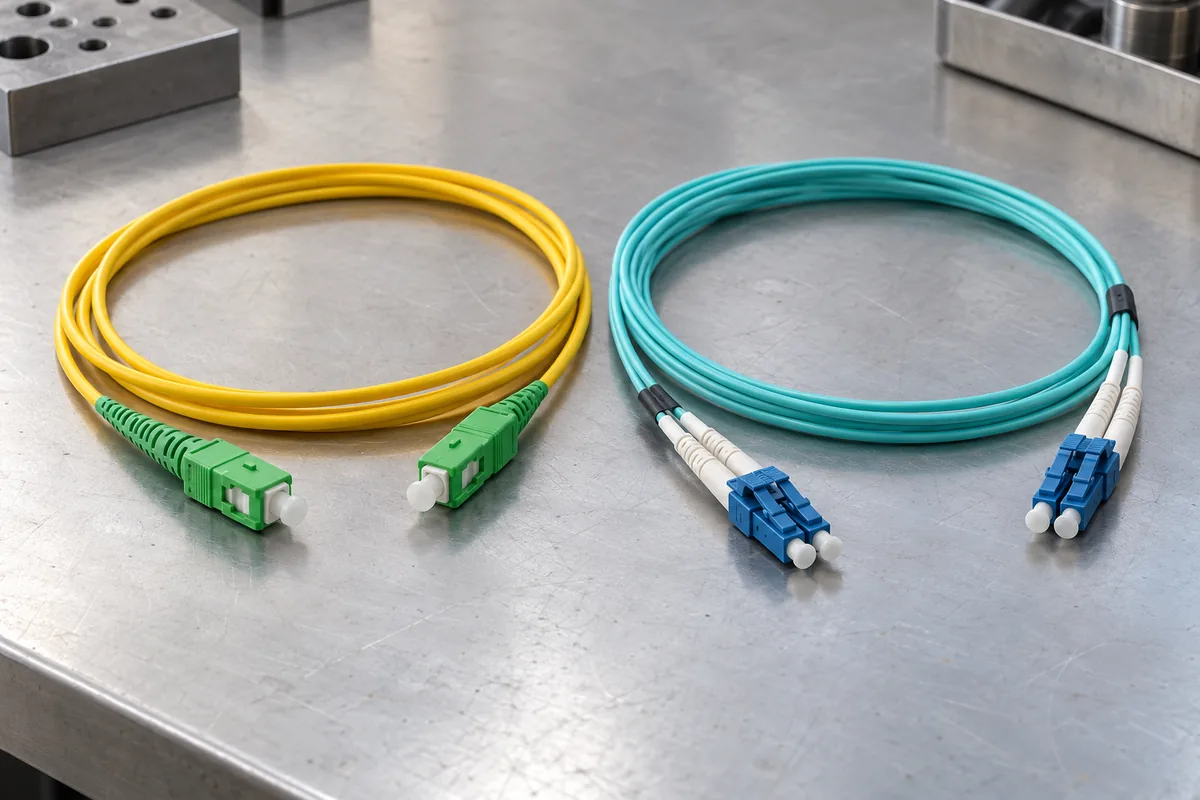
A factory test report is the measurement record for the assemblies in a lot. A loss budget is a plan. They are not the same document.
Last reviewed 2026-11-10. This guide says what to require, and how to read what you are given, for patch cords, pigtails, PLC splitters and MPO. It uses public standards only. It does not say that any order placed here includes a particular report, a particular limit or a 100 percent test. Put the report in the purchase order if you need it.
Planning numbers for a link belong in the fiber loss calculator. An upgrade from GPON to XGS-PON, including where an OTDR trace shows a bend, is covered in GPON to XGS-PON: check the loss budget.
Name the product and the method before the number
A useful report identifies the thing that was measured and the way it was measured. Without those, two numbers cannot be compared.
Ask every report to show:
- The product: patch cord, pigtail, PLC splitter or MPO, with the part identity and the connector and polish.
- The lot or serial identity, and the date.
- The standard and the edition the factory used.
- The method, the wavelength and, for a multi-fiber connector, the fiber position.
- The result for each port or fiber, not only an average.
- The limit the unit was accepted against, written as a maximum or a minimum, not only the word “pass”.
Insertion loss: IEC 61300-3-4
IEC 61300-3-4:2023 describes how to measure the attenuation of an optical component. The standard uses “insertion loss” as another name for that attenuation. The reference method is a light source and a power meter. OTDR is an alternative method, not the reference.
The power-meter methods include cutback, substitution and insertion. The method changes the number. Substitution can read lower than insertion for some devices, because the reference cord’s own loss sits inside the reference reading. A report that says “IL 0.2 dB” and does not name the method is not comparable with a report that used a different method.
Ask the report to state the edition, the method, the wavelength and the result for that assembly. Random-mate attenuation is a different measurement (IEC 61300-3-34 and IEC 61300-3-45). If the purchase order needs random mate, name those parts. Do not assume a patch-cord attenuation test is a random-mate test.
Return loss: IEC 61300-3-6
IEC 61300-3-6:2008 defines return loss as the ratio of the power incident on the device to the power reflected by it, in decibels. Under that definition, a higher return loss means less light coming back. Insertion loss and return loss are different measurements. A pass on one does not pass the other.
Ask for the method, the wavelength, the polish (the report should say what was measured, for example UPC or APC) and the result on each port. A catalogue line that only says “return loss greater than” a figure is a limit. It is not a measurement of the lot in front of you. This page does not print a pass/fail decibel value. The limit belongs in your purchase order, taken from the standard or the grade you specified.
Endface: IEC 61300-3-35
IEC 61300-3-35 is the visual inspection of fibre-optic connector endfaces (the edition indexed by IEC at that link is 2022). It sets criteria for scratches and defects by zone. The numeric limits are in the standard. This page does not copy them.
Ask for:
- The edition the factory inspected against.
- A result per connector, or per fiber on an MPO: pass or fail against that edition, and the image or the zone result if you need to see a failure.
- A statement that the inspection followed IEC 61300-3-35. The words “visually checked” do not say which criteria were used.
A dirty endface makes the insertion-loss number worse and hides the connector’s own finish. Inspection comes before the loss measurement, on a cleaned end.
OTDR traces
Ask for the trace file when you need to see events, not only a stamp that says “pass”. A trace you can read names:
- Wavelength.
- Pulse width.
- The group index (refractive index) used to turn time into length.
- Direction.
- Length.
- An event table: position and loss of each event.
IEC 61300-3-4 keeps the power meter as the reference for component attenuation. Use the trace to locate an event. Use the power meter when the order requires the reference method. For cable on a reel, say that you want the factory reel trace. For a route that is already installed, IEC 61280-4-2:2024 covers attenuation and optical return loss of installed single-mode cabling, with a light source and power meter and with an OTDR. Ask which of the two documents you are being given. A reel trace does not describe the installed route.
Typical versus maximum
Suppliers print both words, and they are not interchangeable.
- Typical is a representative value. It is not a promise that every unit is at or under that number.
- Maximum insertion loss is a limit on loss. A unit above it fails that limit.
- Minimum return loss is a limit on return loss. A unit below it fails that limit, because less return loss means more light coming back.
A quotation that gives one decibel figure and does not say typical or maximum has not stated a limit. Ask which figure the price is based on. Ask the purchase order to name the limit. Ask the factory report to show each measured unit against that limit, with any failure listed. The planning allowances in the fiber loss calculator are for designing a link. They are not a factory result and they are not a limit for accepting a lot.
Sample size
Ask one question in writing: was every assembly in this lot measured, or a sample?
If it was a sample, the report should show the lot size, the sample size and the accept/reject rule. A file that lists three cords does not describe a lot of three thousand unless the sampling plan says how those three were chosen and what happens when one fails. This page does not recommend an AQL or any other sample size. Agree it in the order. If you need every assembly measured, write “100 percent” in the order and expect one result per assembly.
MPO
An MPO result is one result per fiber position, not one number for the connector. Ask for insertion loss and return loss at each fiber, the wavelength, the method, and the endface result per fiber under IEC 61300-3-35. Polarity (method A, B or C, and which end is which) is a separate check. The method names are in MPO polarity methods. A single “MPO IL” with no fiber position can hide one bad fiber.
PLC splitters and pigtails
For a PLC splitter, ask for insertion loss on each output port, the wavelengths used, and whether the figure includes the connectors. Ask for the maximum the port was accepted against, and for the measured value of each port in the lot or in the agreed sample. Uniformity is the spread across those ports. A catalogue maximum is not a measurement of the cassette you received. Compare ratios in the splitter loss calculator, and the way a split fits a GPON budget in PLC splitter ratios and the GPON loss budget.
For a pigtail, ask for the same insertion-loss, return-loss and endface items as a patch cord, on the connector end, and for the fiber identity (grade and length) so the report matches the part.
What to write on the purchase order
| Line | Write this | Reject a file that only says |
|---|---|---|
| Identity | Part, connector, polish, lot or serial | “Standard patch cord” |
| Insertion loss | IEC 61300-3-4, edition, method, wavelength, limit (maximum) | A single decibel with no method |
| Return loss | IEC 61300-3-6, edition, wavelength, limit (minimum) | “RL pass” |
| Endface | IEC 61300-3-35, edition, result per connector or per MPO fiber | “Visually checked” |
| OTDR, if you need events | Wavelength, pulse width, group index, direction, length, event table, and the file | “OTDR OK” |
| Coverage | 100 percent, or lot size, sample size and accept/reject rule | “Tested” with no count |
| MPO | Per-fiber IL and RL, polarity, per-fiber endface | One number for the whole connector |
| PLC | Per-port IL, wavelengths, connectors included or not, maximum | The catalogue table reprinted with no measured ports |
Send a BOM and name the reports you need
Or email the list to sales@zerolineai.com. Asking for a report is not a statement that a report of any particular kind is already attached to an order.
What we test and what ships with your order
What ships with a connectorised order, when you ask for it in the purchase order, is the report this page already describes: insertion loss, return loss for single-mode, an end-face inspection, polarity on an MPO, and an OTDR trace when you asked for events. Cable on a drum ships with the OTDR data for that drum, as the order terms on this site already say. The layout below is a blank. It is not a measurement.
Sample format
| Field | Sample format |
|---|---|
| Assembly identity | — |
| Insertion loss (IL), wavelength and method | — |
| Return loss (RL), wavelength | — |
| End-face inspection | — |
| OTDR: wavelength, pulse, length, events | — |
| Polarity (MPO) | — |
No cell above is a measured result. Write the limits you accept into the order, and read the file that comes back against that order.
Next guide Fiber optic cable prices in 2026: what fiber, cable and FTTH parts cost from China